
If you’re a primary care physician in California or Texas, you already know the drill: a patient’s PHQ-9 is climbing, their SSRI isn’t working, and the nearest psychiatry appointment is weeks away. You manage it yourself because there’s no other option.
The Collaborative Care Model for PCPs (CoCM) in California changes that equation. Instead of referring patients out and hoping they get seen, many practices are shifting toward consultation-based behavioral health models. Our primary care psychiatry referral guide explains when referral, consultation, or collaborative care works best for PCPs.
Here’s what it looks like and why 2026 is the year it starts to make financial sense.
What Is the Collaborative Care Model For PCPs?
Collaborative care model in Texas is a structured partnership between three people:
| Role | What They Do |
| You (PCP) | Lead the care. Screen, prescribe, manage treatment. Nothing changes about your role. |
| Care Manager | Tracks patients with PHQ-9/GAD-7, coordinates care, and flags those who aren’t improving. Often, your existing nurse or social worker. |
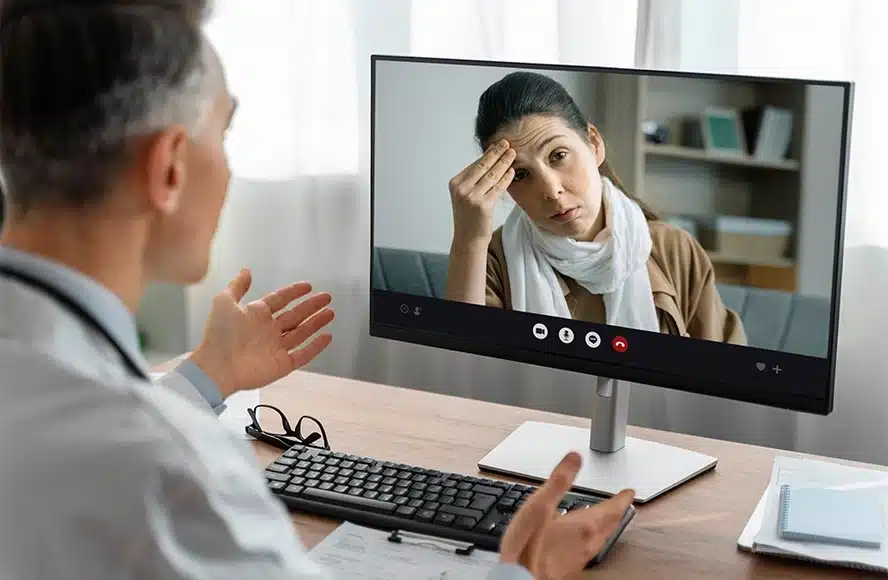
| Psychiatric Consultant | Reviews your caseload weekly via telepsychiatry. Provides diagnostic guidance and medication recommendations. Available for direct evaluation when needed. |
The key insight: in traditional psychiatry, a provider sees 1–2 patients per hour. In CoCM, one consultant can review 10–15 cases per hour through structured caseload consultation, a model widely used in telepsychiatry caseload consultation in Texas programs. That’s how a single psychiatrist supports your entire behavioral health panel.
Why 2026 Changes the Math
CoCM has been around for 30 years, with over 90 clinical trials supporting it. What held it back was the business case. Three things changed:
- Simpler documentation. CMS removed the time-based tracking requirements that made the old CoCM codes impractical for busy practices.
- Better reimbursement. New 2026 add-on codes (GPCM1, GPCM2, GPCM3) stack on existing APCM codes, strengthening CoCM reimbursement 2026 GPCM codes opportunities for primary care practices. Your practice bills and keeps all CoCM revenue.
- Telepsychiatry makes psychiatric consultation scalable. across multiple practices. A consultant supporting primary care teams in California or Texas can review cases without geographic limitations. If you’re evaluating care delivery options, our guide on telepsychiatry vs in-person psychiatry explains how each model compares for primary care settings.
The California and Texas Picture
Both states face acute psychiatric shortages, but the dynamics differ:
| California | Texas | |
| Psychiatric shortage | Severe in rural/inland areas. Better in metro, but wait times still 4–8 weeks in LA/OC/SD. | 380 Mental Health HPSAs. 614 practitioners needed. Especially acute in Southeast TX. |
| Telehealth policy | Strong telehealth parity laws. Audio-only permitted for behavioral health. | Permanent telehealth parity since 2023. Favorable for CoCM implementation. |
| Opportunity | Large Medicaid (Medi-Cal) population. Managed care plans increasingly requiring BH integration. | Fastest-growing state. Large uninsured population drives self-pay and employer-sponsored demand. |
Whether your practice is in Anaheim, Houston, San Diego, or Dallas, the pattern is the same: rising demand, shrinking supply, and patients waiting too long between your office and a psychiatrist’s.
You Probably Already Have the Infrastructure
Here’s the part that surprises most practices: if you already have a care manager, nurse coordinator, or social worker handling chronic disease management or CCM billing, you already have the person who runs the behavioral health registry as part of integrated behavioral health California programs. For many physicians researching how to add psychiatry to primary care practice California, the answer is often simpler than expected because the core team and workflows may already exist within the clinic.
Same skills — tracking a panel, administering screening tools, following up between visits, and escalating when someone isn’t improving. These are the same care coordination skills used in integrated behavioral health Texas programs. Your team already does this for diabetes, and they can apply the same approach for depression.
The only new cost is the psychiatric consultant. And the CoCM revenue more than covers it.
What a Partnership with MindVibe Looks Like
A telepsychiatry PCP partnership with MindVibe Psychiatry helps CoCM primary care practices integrate behavioral health services through a collaborative care framework while maintaining full control of patient relationships.
MindVibe Psychiatry provides the psychiatric consultant for your CoCM program. Here’s how the process works:
- We assign a board-eligible or board-certified psychiatric consultant to your practice. You can meet our psychiatric consultants and learn about their expertise supporting collaborative care programs.
- Weekly caseload reviews with your care manager (30–60 minutes, via secure video).
- Diagnostic guidance, medication recommendations, and treatment adjustments are documented in your EHR.
- Direct patient evaluation available via telepsychiatry when the clinical picture warrants it.
- Your practice bills and keeps all CoCM codes. The revenue is yours.
- We help with setup, training, registry design, and ongoing support.
We accept all major insurances, including Medicaid and Medicare. We also offer affordable self-pay options.
Interested in Collaborative Care for Your Practice?
We’ve prepared a financial framework showing per-patient revenue, panel-level projections, and partnership structures for practices in California and Texas.
Contact Dr. Kalidindi directly: ravi.kalidindi@hybridhealthsystems.com
Or explore our telepsychiatry services to see how MindVibe supports primary care practices with psychiatric consultation.