
A Note to My Fellow Physicians
If you are a primary care physician reading this, I do not need to tell you that mental health has become one of the most demanding parts of your practice. You already know. You are managing more patients with depression, anxiety, ADHD, and trauma-related conditions than at any point in your career often without adequate access to psychiatric specialists, and without always having clear psychiatrist referral guidelines to rely on.
I write this from a somewhat unusual vantage point. I am a board-certified physician who spent years in primary care and urgent care before pursuing a PCP-Psychiatry fellowship at UC Irvine. As Chief Medical Officer of Hybrid Health Systems, the parent organization behind MindVibe Psychiatry, I now oversee clinical operations across multiple brands in California and Texas. I have been on your side of the referral, managing patients with SSRIs and hoping the dose would hold. And I have been on the psychiatry side, receiving referrals and wishing the PCP had sent the patient sooner.
This guide is what I wish I’d had when I was in primary care. It is a practical, clinically grounded framework for knowing when your patient needs more than what you can comfortably provide and how to make that referral effective.
For PCPs seeking evidence-based guidance on when to refer a patient to psychiatry, this clinical collaboration guide is an excellent resource. It outlines key scenarios for referral, such as treatment-resistant depression, complex diagnostic cases, and situations requiring medication optimization or specialty care.
What Most PCPs Can Comfortably Manage
Primary care physicians are fully capable of diagnosing and treating a wide range of mental health conditions. In fact, the majority of antidepressant prescriptions in the United States are written by PCP practices, not psychiatrists. You are not overstepping you are filling a critical gap.
The conditions most PCPs can manage effectively include:
- Mild to moderate depression: First-line SSRI or SNRI therapy with standardized monitoring (PHQ-9) and follow-up.
- Generalized anxiety disorder: SSRI/SNRI as first-line, buspirone as adjunct, with GAD-7 tracking.
- Adjustment disorders: Supportive care, short-term medication if needed, counseling referral.
- Insomnia: Sleep hygiene education, melatonin, trazodone, or hydroxyzine. Avoiding benzodiazepine dependence.
- Uncomplicated grief: Distinguishing normal grief from major depressive disorder. Supportive management.
If your patient is responding to first-line treatment, following up reliably, and showing improvement on validated measures, you are doing excellent work. Not every patient with a mental health concern needs a psychiatrist.
Clinical Red Flags: When To Refer A Psychiatrist
The following scenarios should prompt a referral to psychiatry. These are not rigid rules — they are clinical signals that the complexity of the case exceeds what can be safely and effectively managed in a primary care setting.
⚠️ Refer Promptly – High-Priority Red Flags
Active suicidal ideation with plan or intent • Psychotic symptoms (hallucinations, delusions, disorganized thinking) • Suspected or confirmed manic episode • Severe self-harm or escalating self-injurious behavior • Acute danger to self or others (note: this may require emergency services, not just referral).
| Clinical Scenario | Why Referral Helps | What to Include in Referral |
| Treatment-resistant depression: patient has not responded to 2+ adequate antidepressant trials | Psychiatry can evaluate for bipolar spectrum, augmentation strategies (lithium, atypical antipsychotics, thyroid optimization), or treatment alternatives like Spravato. | Medications tried with doses/durations, PHQ-9 scores over time, any side effects, substance use screen results. |
| Diagnostic uncertainty: overlapping symptoms that could indicate multiple conditions | A psychiatrist must know when to refer for psychiatric evaluation to differentiate between conditions like ADHD vs. bipolar II, PTSD vs. BPD, or depression vs. early dementia. | Your clinical impression, what you have ruled out, relevant medical workup, family psychiatric history. |
| Complex polypharmacy: patient is on 3+ psychotropic medications | Psychiatry can rationalize the medication regimen, reduce drug interactions, and develop a streamlined treatment plan. | Complete medication list with start dates, which provider prescribed each, and clinical rationale. |
| Bipolar disorder (suspected or confirmed) | Mood stabilizers and atypical antipsychotics require monitoring expertise. Antidepressant monotherapy in bipolar can trigger mania. | Mood charting if available, family history, any hypomanic/manic episodes, current medications. |
| Schizophrenia spectrum disorders | Antipsychotic selection, metabolic monitoring, clozapine consideration, and long-acting injectable management require specialty expertise. | Symptom timeline, prior medication trials, adherence history, functional status. |
| Substance use disorder with co-occurring psychiatric conditions | Dual-diagnosis management requires careful medication selection. Some medications interact with substances of abuse or are themselves addictive. | Substances used (type, frequency, route), current withdrawal risk, prior treatment, psychiatric symptoms timeline. |
| Eating disorders with psychiatric comorbidity | Eating disorders frequently co-occur with depression, anxiety, OCD, and trauma. Psychiatric management ensures medication choices support both conditions. | Weight/BMI trajectory, purging behaviors, medical complications, current psychiatric symptoms. |
| Patient request or preference for psychiatric evaluation | Honoring the patient’s wish for specialist input strengthens the therapeutic relationship and may improve adherence. | Your assessment, current treatment, and what specifically the patient is hoping to address. |
How to Make a Psychiatric Referral That Actually Works
A referral is only useful if the patient follows through. Research shows that a significant percentage of primary care mental health referrals are never completed. Here is what increases the likelihood of a successful handoff:
- Normalize the referral: Frame it as a sign of thorough care, not failure. “I want to bring in a specialist who focuses exclusively on this, the same way I’d refer you to a cardiologist for a heart concern.”
- Be specific about why: Patients are more likely to follow through when they understand the clinical reasoning. “Your depression hasn’t responded to two medications, and a psychiatrist has additional tools and expertise to help us figure out the next step.”
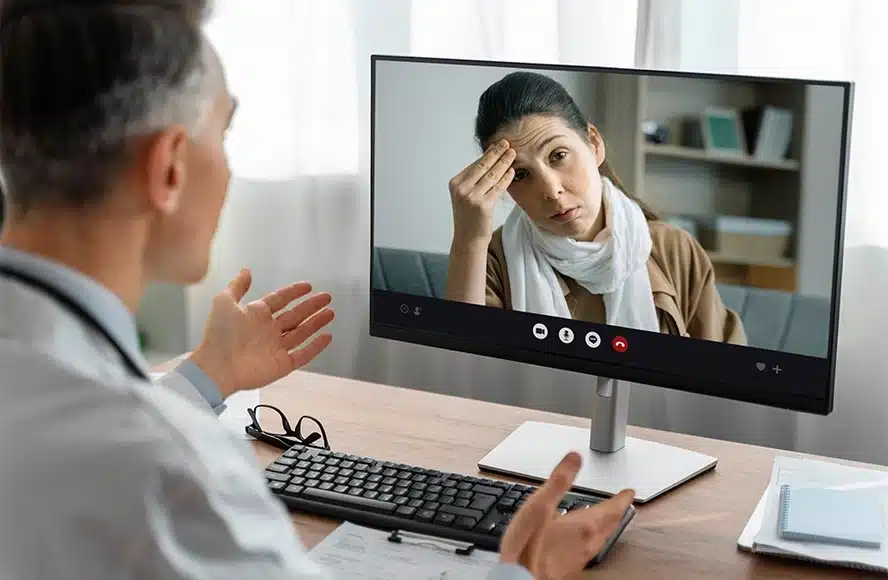
- Reduce friction: Offer telepsychiatry as an option. Many patients do not follow through on referrals because of transportation, scheduling, or the anxiety of visiting a new clinic. Virtual psychiatry eliminates most of these barriers.
- Provide a warm handoff when possible: If you can, introduce the patient to the psychiatric practice directly or have your staff help schedule. Active referral assistance dramatically increases completion rates compared to simply handing the patient a phone number.
- Send relevant clinical information: A referral with medication history, screening scores, and your clinical impression helps the psychiatrist hit the ground running. It also reduces redundancy for the patient and supports an efficient treatment-resistant depression referral process.
- Stay involved: The best outcomes happen when PCP and psychiatrist collaborate. Let the patient know you are not handing them off you are building a team around them.
A Note on Telepsychiatry Referrals
If your patient faces long wait times, transportation challenges, or lives in an underserved area, a telepsychiatry referral can be a game-changer. At MindVibe, new patients can typically be seen within 3 business days through our virtual platform. We provide referral coordination and send clinical updates back to the referring PCP so you stay informed and involved.
Common Mistakes: When PCPs Wait Too Long to Refer
In my experience on both sides of the referral, these are the most common patterns where earlier referral would have led to better patient outcomes:
- Continuing to titrate antidepressants past 2 adequate trials without a psychiatric consultation. Treatment-resistant depression often requires augmentation strategies or diagnostic reconsideration that falls outside typical PCP scope. and may clarify when should a doctor refer to a psychiatrist.
- Prescribing benzodiazepines long-term for anxiety without exploring alternatives. A psychiatrist can offer a more sustainable medication strategy and address the underlying disorder rather than managing symptoms with a medication that carries dependence risk.
- Attributing mood instability to “stress” or “personality” without screening for bipolar spectrum disorders. Bipolar II is frequently missed in primary care because hypomania is underrecognized.
- Avoiding the referral conversation because the patient “seems fine” between episodes. Many psychiatric conditions are episodic. A patient who is stable today may have had significant symptoms last month. Periodic severity does not mean the condition is mild.
- Assuming the patient will refuse. Many PCPs avoid suggesting psychiatry because they expect resistance. In practice, when the referral is framed properly, most patients are relieved that their physician is taking their mental health seriously enough to involve a specialist.
The Collaborative Model: How PCP and Psychiatrist Work Together
The most effective mental health care is not PCP or psychiatrist — it is PCP and psychiatrist. Here is what that looks like in practice:
- PCP manages: Screening, initial treatment, monitoring for mild to moderate cases, medication refills when the patient is stable, coordination of overall health.
- Psychiatrist manages: Diagnostic clarification, complex medication regimens, treatment-resistant cases, conditions requiring specialty medications (lithium, clozapine, Spravato, Suboxone), and ongoing management of severe mental illness, and cases involving a bipolar referral from primary care.
- Both collaborate on: Medication interactions (especially when the patient is on psychotropics plus other medications), lab monitoring, treatment planning, and ensuring the patient does not fall through the cracks between providers.
At MindVibe, we are built around this model. Our psychiatrists send clinical summaries to referring PCPs after each visit. We coordinate medication changes and flag any concerns. You are never out of the loop.
Frequently Asked Questions from Referring Physicians
Does my patient need a referral to see a psychiatrist?
It depends on their insurance plan. Some plans require a PCP referral to psychiatry, while others allow direct access. We recommend checking the patient’s plan or having them contact our intake team we can verify insurance and referral requirements quickly.
How quickly can my patient be seen?
At MindVibe, new patients can typically schedule a telepsychiatry appointment within 3 business days. In-person appointments at our Houston and California locations may vary. Our intake team can provide specific availability.
Will I get updates on my patient’s care?
Yes. With the patient’s consent, we send clinical summaries to the referring provider after each visit. We also reach out proactively if there are medication changes or clinical concerns that require PCP coordination.
Can you see patients in both California and Texas?
Yes. MindVibe provides both telepsychiatry and in-person services across California and Texas. Our psychiatrists are licensed to practice in both states, and our virtual platform allows patients to receive care from anywhere within those states.
Refer a Patient to MindVibe
We make the referral process straightforward. You can contact our intake team directly at intake@mindvibe.com or call our office. We accept referrals by phone, fax, and secure email. New patients are typically seen within 3 business days via telepsychiatry. We will keep you informed every step of the way.